Showing posts with label SG-DQ. Show all posts

Wednesday, June 23, 2010

SG ~ third set of DQs

1.  This is how Pearl sees emotional abuse.  Do you agree with her?
"People say you need to be strong, smart, and lucky to survive hard times, war, a natural disaster, or physical torture.  But I say emotional abuse — anxiety, fear, guilt, and degradation — is far worse and much harder to survive.  This is the first time that May and I have ever experienced anything like this, and it saps our energy" (p. 43)
2.  Pearl is a Dragon, and May is a Sheep.  Do you thik the two sisters are true to their birth signs in their actions in the novel?

3.  Which sister is smarter?  Which is more beautiful?

4.  Each sister believes that her parents loved the other sister more.  Who is right about this?  Why?

5.  How would you describe the relationship between Pearl and May?  How does the fact that both are, in a sense, Joy's mother affect their relationship toward each other?  Who loves Joy more and how does she show it?

6.  There are times when it seems like outside forces conspire against Pearl -- leaving China, working in the restaurant, not finding a job after the war, and taking care of Vern.  How much of what happens to Pearl is a product of her own choices?
__________

NOTE:  Has everybuddy finished reading the book?  If so, go ahead and talk about the whole novel.

Wednesday, June 16, 2010

SG ~ second set of questions

1.  What was it like for immigrant Chinese people at Angel Island (see actual photo above of women waiting for their hearings)?

2.  What were some of the hardships Pearl and May went through -- before, during, and after their stay on Angel Island?

3.  What were paper sons?  How did paper sons drive the storyline?

4.  What did you think of China City, the tourist attraction that was intended to look and feel like an "authentic" Chinese city?

5.  Why do you think nobody insisted that May take care of her own husband?

This is the Garnier Building, seen from the Los Angeles Street side, where Pearl and May lived when they first moved to Los Angeles.  The cars indicate the photo was probably taken in the late 1930s or early 1940s.  Today the Garnier Building is home to the Chinese American Museum.

Saturday, June 5, 2010

SG ~ first set of questions

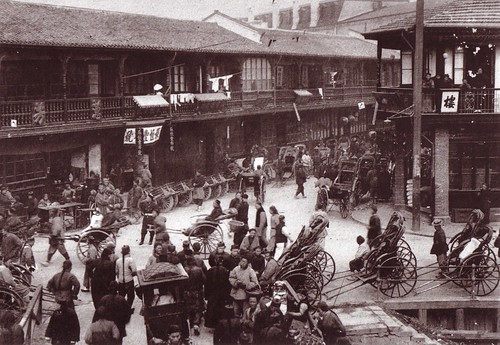
The Old Chinese City in Shanghai. by writersee.
The Old Chinese City in Shanghai

1.  We have a saying that "sticks and stones may break my bones, but words can never hurt me."  Yet Pearl felt very hurt by her father's words, near the beginning of the book.  When have you experienced something similar?
"This is another of my father's standard criticisms and one he picked up from Confucius, who wrote, 'An educated woman is a worthless woman.'  People calle me bookish, which even in 1937 is not considered a good thing.  But as smart as I am, I don't know how to protect myself from my father's words" (pp. 3-4).
2.  The novel begins with Pearl saying, “I am not a person of importance” (p. 3).  After Yen-yen dies, Pearl comments:  “Her funeral is small.  After all, she was not a person of importance, rather just a wife and mother” (p. 246).  How do you react to comments like these?

3.  These quotes from the first chapter show us a major cultural difference for most westerners today.  Try to imagine how you would feel if your father said this to you, and then the man you had a crush on (Z. G.) backs up what your father said.
Their father:  "I've arranged marriages for the two of you ... The ceremony will take place day after tomorrow" (p. 19).

Pearl:  "I'm to be sold -- traded like so many girls before me -- to help my family.  I feel so trapped and so helpless that I can hardly breathe" (p. 26).

Pearl:  "In the end, Z. G. says the one thing I didn't expect.  'You should marry the man.  He sounds like a good match, and you have a duty to your father.  When a girl, obey your father; when a wife, obey your husband; when a widow, obey your son.  We all know this is true" (p. 30).
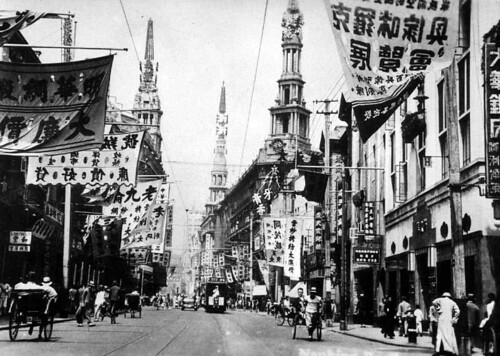
Shanghai's Nanjing Road in the 1930s. by writersee.
Shanghai's Nanjing Road in the 1930s