Showing posts with label Bonnie. Show all posts

Wednesday, February 20, 2013

Justice ~ by Michael J. Sandel


Justice: What's the Right Thing to Do? ~ by Michael J. Sandel, 2009
What are our obligations to others as people in a free society?  Is it sometimes wrong to tell the truth?  Is it possible, or desirable, to legislate morality? Is killing sometimes morally required?  Do individual rights and the common good conflict?  Should government tax the rich to help the poor?  Is the free market fair?  Michael J. Sandel’s “Justice” course is one of the most popular and influential at Harvard.
"Justice" is one of the most popular courses in Harvard’s history.  Harvard has opened its classroom to the world.  Professor Michael Sandel challenges us with difficult moral dilemmas and asks our opinion about the right thing to do.  He then asks us to examine our answers in the light of new scenarios.  The results are often surprising, revealing that important moral questions are never black and white.   This course also addresses the hot topics of our day — affirmative action, same-sex marriage, patriotism and rights, torture, stealing a drug that your child needs to survive.  Notice that each of these twelve classes has two topics, which we'll discuss separately.

Harvard class videos
Harvard assigned readings
About the author
Harvard faculty page
Wikipedia
DISCUSSION QUESTIONS
1a ~ The Moral Side of Murder
1b ~ The Case for Cannibalism
2a ~ Putting a Price Tag on Life
2b ~ How to Measure Pleasure
3a ~ Free to Choose
3b ~ Who Owns Me?
4a ~ This Land is my Land
4b ~ Consenting Adults
5a ~ Hired Guns?
5b ~ Motherhood: For Sale
6a ~ Mind Your Motive
6b ~ The Supreme Principle of Morality
7a ~ A Lesson in Lying
7b ~ A Deal is a Deal
8a ~ What's a Fair Start?
8b ~ What Do We Deserve?
9a ~ Arguing Affirmative Action
9b ~ What's the Purpose?
10a ~ The Good Citizen
10b ~ Freedom vs. Fit
11a ~ The Claims of Community
11b ~ Where Our Loyalty Lies
12a ~ Debating Same-sex Marriage
12b ~ The Good Life


You are welcome to watch Harvard's video, do the readings they provide (not all episodes have related readings), and come here to see what's being said.  You can answer earlier questions as well as the current one.

Here's your first question:   Does morality interest you enough that you'll join us in exploring the ideas?  (Answer this one in the comments below.)

Saturday, January 5, 2013

Mary/Zorro's links about monarchs

Monarch #1
http://texasbutterflyranch.com/
www.monarchwatch.com www.mlmp.org
http://www.learner.org/jnorth/monarch/
http://www.monarchjointventure.org/
http://monarchwatch.org/bring-back-the-monarchs/
http://www.monarchparasites.org/

Monarch #2

Bonnie's question:  Which is which?

One thing I like about reading Barbara Kingsolver's novels is that I learn as I read.  For instance, I now know that one of these two butterflies is a male, and the other is a female.  Without reading anyone else's comment first, tell me which is which. 

Flight Behavior ~ January 2013

Flight Behavior ~ by Barbara Kingsolver, 2012, fiction (Tennessee)
In the opening scene in the rural community of Feathertown, Tennessee, 29-year-old Dellarobia Turnbow is headed for a secluded mountain cabin to meet a man and initiate what she expects will be a self-destructive affair.  But the tryst never happens.  Instead, she walks into something on the mountainside she cannot explain or understand:  a forested valley filled with silent red fire that appears to her a miracle.  The arrival of a research team led by Ovid Byron reveals the troubling truth behind the butterflies' presence, that they've been driven by pollution from their usual Mexican rywinter grounds and now face extinction due to northern hemisphere temperatures.  Already restless in her marriage to the passive Cub, for whom she gave up college when she became pregnant at 17, unsophisticated, cigarette-addicted Dellarobia takes a mammoth leap when she starts working with the research team.  As her horizons expand, she faces a choice between the status quo and, perhaps, personal fulfillment.
Author's website
Videos ~ butterflies, interview, etc.
Mary/Zorro's links about monarchs
Monarch in San Antonio
DISCUSSION QUESTIONS
Male or female question
FB ~ first set of questions
FB ~ Ch. 3 Congregational Space
FB ~ Ch. 4 ~ Mexico
FB ~ clearcutting in Michoacan
FB ~ Education
FB ~ Dellarobia's options
FB ~ climate change, science, and religion
FB ~ stereotypes, social issues, the media
FB ~ themes
FB ~ final quote and book question

Sunday, November 25, 2012

Flight Behavior ~ by Barbara Kingsolver

Mary/Zorro has nominated Flight Behavior by Barbara Kingsolver (Nov. 2012) as our next book.
It's a novel set in the mountains of East Tennessee, in a Bible-belt community that thinks the coming of monarch butterflies is a miracle from God — while the scientists think it's an ecological disaster caused by climate changes.
Flight Behavior sounds to me like it's right up our alley, Shirley says it sounds good to her, Alison has already gotten this book from the library, and — I'll let you in on Zorro's secret life that I learned as she was planning her visit here to Tennessee and emailed this:
"Would you like to see the new Monarch butterfly 3D IMAX movie with us?  Do you know that I do teacher workshops for the Monarch Larvae Monitoring Project?   I don't think I have mentioned that I am a butterfly enthusiast!  I also help with a monarch research group at the Univ. of Georgia.  So I am very excited to see the movie while I am there.   It is not showing here."
Aha!  Mary is an expert on butterflies, especially monarch butterflies.  I'd say having a knowledgeable person in our midst would make the discussion of this book all the more interesting.

Because it's a new book, my library allowed me only seven days to read and return the book.  It may be difficult for you to get, too.  We won't read our next book until January, so some of you may get a copy feom Santa, if you ask early enough.  Read more about it here at an NPR site about Barbara Kingsolver that Donna found for us.  These three links are specifically about Flight Behavior:
Does this novel interest you?


Watch live streaming video from goodreads at livestream.com
Zorro found this video for us.  Thanks, Mary/Zorro.

Update:  Mary/Zorro also found this article on "Fall of the Monarchs" = http://inthesetimes.com/article/14215/fall_of_the_monarchs/

Let's have a party! I'll invite Diana Butler Bass

Essencia Island is the place book buddies party at the end of a book discussion.  Click on the photo on the sidebar (or this link), and you'll arrive at a warm and sandy place where we can chat without cluttering up the comments about the books on this blog.  It's our place to relax, get to know each other, and talk informally.

My very first post on the island tells you how it all started.  If you click "Newer Post" at the bottom of the post (and continue with other posts), you can read about all the parties we've held on Essencia Island.  Back when we met on Oprah's site, we created an imaginary island as something "essential" to who we book buddies are.  Now we have our own virtual island.  Feel free to explore it and leave a post, if you want to chat.  Go ahead — I've already left you a message there.

Sunday, November 18, 2012

Epilogue – Home Again

"In her sermon Anne explains that Lent is not about being sad, not some sort of spiritual penance.  Rather, she insists, Lent is about change the change that God can make in our selves, our faith communities, and the larger world.  Lent is a time that opens our hearts to transformation, to becoming God's people and doing that which God calls us to do" (p. 281).
1.  Is the Reverend Anne Howard right?  Is "transformation the promise at the heart of the Christian life"?

2.  What are the implications of transformative Christianity in your own life, for the life of your congregation, and for the larger community of which you are part?

Saturday, November 17, 2012

Chapter 17. Transforming the World

"Instead of being involved in politics as they were in the 1970s — primarily  the politics of policy and protest — they engaged in hands-on personal politics, things like setting up homeless shelters and local environmental projects" (p. 259).
1.  Why do we engage, to use Jack Harrison's phrase, in "all this for-the-church activity"?  What do you think is the point, the larger goal, of being part of a church or even being a Christian?

2.  What do you think of St. Mark's response to 9/11?  What most surprises you about St. Mark's attitude toward political questions?

3.  What color is your congregation?

4.  What does it mean to "reclaim" the message of Christianity?

5.  Reflect on the political concerns of the two Methodist churches in Florida.  What do the Florida congregations suggest about the role of religion in public life?

6.  Do you think the "left-right" paradigm works for American religion?  Why or why not?

Sunday, November 11, 2012

Chapter 16. Transforming Congregations

"This is a jazz church ... Not just improvisation, but jazz in the sense that jazz pulls in all styles of music.  You have to listen to everything.  You become a better player.  It comes out in your music."
p. 247 in Christianity for the Rest of Us

1.  How might your congregation respond if your minister preached a sermon like Bruce Freeman's?  As a community, do you welcome change?  Fear it?  Avoid it?

2.  What do you think about the possibility of your congregation experiencing metanoia?

3.  Of the churches described in this chapter, which would you most like to join?  Why?

4.  If your church was not called by its current name (for example, "First Presbyterian," "Our Savior," or "St. Mary's"), what might it be called?  Pick a name that fits with its identity and share with the group the reasons for choosing it.

Saturday, November 10, 2012

Labyrinth at St. Francis of Assisi

Mary (Zorro) searched out this labyrinth at an Episcopal church in Ooltewah, across town from where I live.  She and Donna (AuntyDon) and I arranged to meet there Friday morning to walk the labyrinth.  As we walked in silence, I collected a small pinecone that had fallen onto the sandy path among the brown leaves, and I saw Donna bend down to touch the black stones of a tile in the next picture.

These three stone tiles were placed at the beginning (which is also the end) of the path we walked.  The Alpha and Omega are separated by a tile showing a cross with a colorful glass (?) center.  All were designed with smooth inlaid stones.  If you were to walk across these tiles, rather than following the brick-outlined path, you'd be going straight into the center of the labyrinth...

...which is here.  Yesterday was a chilly morning, as you can see by the jackets.  Mary and Donna are standing at "9 o'clock" and "12 o'clock" on the cross in the center, meditating.  Mary looked up, Donna looked down, and I looked at my viewfinder to snap this picture before taking my place at the "3 o'clock" arm of this cross.  The entrance/exit for the center was at "6 o'clock" in line with Donna.

Mary approaches the end of "unwinding" herself out of the labyrinth.  (See those three white tiles?)  Later, she suggested we should write a booklet telling people how to pray the labyrinth.  Donna pointed out what she read at the St. Paul labyrinth, that there's no one right way to walk a labyrinth.  This is quoted from the handout we picked up there:
Unlike a maze, a labyrinth offers no tricks, puzzles, or dead-ends.  The design forms a winding unicursal path which leads toward the center and back out again.  This sacred path in a sacred circle simply leads to a deeper connection to God, others, and ourselves. ... There is no right or wrong way to walk the labyrinth.  Walk with an open mind and an open heart and receive whatever is there for you.  Release your expectations.  Focus on your breath.  Find your own individual pace.  There is one way in and one way out.  Those going in will meet those coming out.  You may "pass" others on the path or allow them to step around you.  Do whatever comes naturally.  Use everything as a metaphor.
We three met in the middle and walked out from that center separately, no one close to another except when we passed on adjacent parts of the path.

We ended our time together at Cracker Barrel, eating and having a theological conversation that lasted a couple of hours.  Mary's daughter Cori met us for lunch, and she's the one who took this photo of the three muskateers I mean, the three book buddies.  If you click twice on these photos, you can enlarge them to see more details.  You may even be able to read the quote on my tee-shirt:
"Well behaved women rarely make history."

Sunday, November 4, 2012

Chapter 15. Transforming Lives

"Paul may have been stopped in his tracks on the road to Damascus, but it took three years of living in Christian community and learning its practices for him to be fully changed" (p. 222).
1.  What do you think about Bernard's story?  How might your church respond if Bernard and Catherine had walked in the front door?

2.  What do you think about the word conversion?

3.  Which of the metanoia stories presented in this chapter speaks most strongly to you?  Why?

Wednesday, October 31, 2012

PART III – From Tourists to Pilgrims

Diana Butler Bass uses the word pilgrim in this introduction to Part III in a way that isn't what I usually think when I hear the word.  I looked it up and found five definitions.  The first is what I thought of:
1.  a person who journeys, especially a long distance, to some sacred place as an act of religious devotion: pilgrims to the Holy Land.
But our author seems to be using the fifth meaning.
5. a newcomer to a region or place.
Here's what the book says (on page 216):
"Becoming a pilgrim means becoming a local, a year-round person, who adopts a new place and a new identity by learning a new language, rhythms, and practices.  Unlike being a tourist, we embark on a pilgrimage, not to escape life, but to embrace it more deeply, to be transformed wholly as a person with new ways of being in community and new hopes for the world.  Being a tourist means experiencing something new; being a pilgrim means becoming someone new.  Pilgrimages go somewhere to a transformed life."

Chapter 14. Beauty

"Touching the Divine" is the subtitle of this chapter.  Perhaps the best illustration I can provide for us is to let us actually hear a recorder being played.  Diana Butler Bass shared how people reacted to music in one church:
"As the choir sang, many listened with closed eyes, seeming to experience in almost mystical sense of God's transcendence.  And I was not crying alone; the medieval recorder brought a few other people to tears.  These people live music" (p. 203).
Do you know what a recorder is?  This video shows a quartet (Loeki Stardust Quartett Amsterdam) playing recorders of different sizes.  (If the video quits working, view it on YouTube by clicking the link.)


1.  What is the role of music and art in your spiritual life?  In your congregation?

2.  How do you respond to the interview with the Reverend Alice Connor?  To Phyllis Tickle's story about the teenage boy?  Do Alice's and the boy's comments make sense to you?  Do they help you better understand the Trinity or the Virgin Birth?  What do you think about beauty as a pathway of theological knowledge?

Chapter 13. Reflection

This chapter is subtitled "thinking theologically."  There's a difference between "learning about Christianity" and "learning Christianity."  To use a phrase coined by Marcus Borg, the Episcopalians at Lynne's Episcopal church took the Bible "seriously, but not literally" (p. 188).
"Bible study is a practice of thoughtful faithfulness, one that blends Christian commitment with openness.  As such, learning moves beyond information and becomes spiritual formation in a way of life, a life, as Lynne had hoped, that nurtures compassion and justice" (p. 188).
1.  How do you understand the Christian life of the mind?  Have you ever thought of intellectual curiosity as a spiritual practice?  Does your church encourage or discourage theological reflection as an important part of the faith journey?  Have you ever considered theological reflection a "way of life"?

2.  What do you think about the difference between liberality and liberalism?

3.  What do you make of the last two paragraphs of this chapter?  Do they reflect your longings?  Your congregation?

Wednesday, October 24, 2012

Another labyrinth

This morning, Donna and I walked another labyrinth.  This time, I was silent and Donna took a photo of me walking along after she had finished.  This is behind Burks United Methodist Church, which is about a mile from where we live, yet I didn't know it was there.

When I posted details on my book blog about walking the labyrinth at St. Paul's Episcopal Church in downtown Chattanooga, I got lots of comments.  Debra, a new friend I met a few months ago, left a comment with locations of several labyrinths in the Chattanooga area:
"Come walk the Labyrinth at Burks UMC.  It's in the back of the property.   It's open 24/7.  It's in the grass.  There are benches inside to sit down upon and benches on the exterior (there is a walking path along the exterior).   There used to be a holder with explanation, but the holder disappeared.  The literature is inside the church currently."
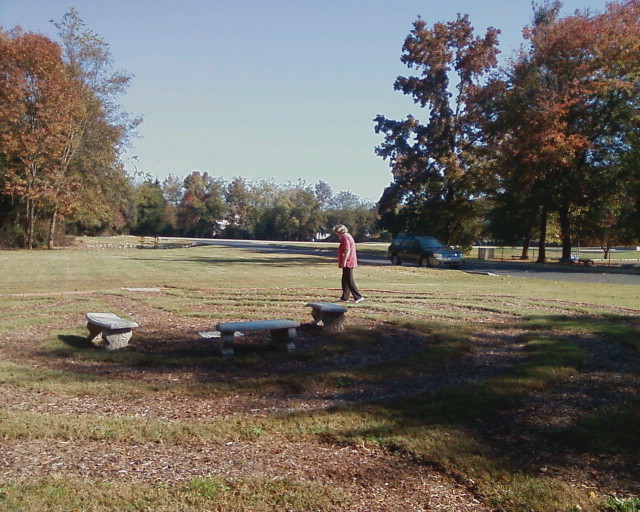
Before lunch, we drove to the church and found the labyrinth near where pre-school children were enjoying the outdoors.  Although we didn't go inside looking for the literature, we attracted the attention of a half dozen children who came to the fence near where we parked and waved at us.  That's my dark green Suburu Outback in the photo with the children in the distance, beyond one of the benches.
The pathway is made of chipped wood between grassy borders, and I saw lots of teensy-tiny mushrooms, some even in the middle of the path.  These along the path's edge are practically gigantic, compared to some I noticed.  I found the unevenness of the path disconcerting, probably because my bifocals blurred the leaves, woodchips, and mushrooms.  I felt myself sway a time or two, but Donna likes this labyrinth much more than the one in St. Paul's courtyard.

(For some reason, only some of the pictures will enlarge twice when you double-click on them.  If it works for you, you can see the uneven paths between grass.)

Tuesday, October 23, 2012

Chapter 12. Worship

The Rev. Danny Gulden, senior pastor at Sandy Springs Christian Church (Disciples of Christ), breaks bread during the worship service on September 16, 2012.  That was the last day of the weekend seminar led at his church by Diana Butler Bass, who preached that morning.  At that window beyond him, you can see music stands for the band that played that day.  To the right is a cross behind the lectern and the pulpit (almost out of sight at the right).


This large cross outside the sanctuary has a variety of mosaics.  Donna, who went with me that weekend, especially liked the symbolism of the clasped hands on the crossbar at the left.  I like the dove representing the Spirit.  To see the images better, click to enlarge photos.


1.  Share frankly your opinion about worship in your current congregation.

2.  Share with the group an experience where you felt the "quarter-second of awe and wonder" as described by Pastor Eric Elnes.

3.  Of the worship experiences described in this chapter, which one most intrigues you?  Why?

Monday, October 22, 2012

Chapter 11. Justice

Harvard has an online course called Justice, based on Michael J. Sandel's huge class and his book called Justice: What's the Right Thing to Do?  Some friends and I spent three months studying that free course.  We read the book chapter by chapter, watched Harvard's videos, and met every Monday at my house to talk about it.  You can read that discussion on my book blog, or even take part in it by adding your comments, if you like.

(Just follow the links.)

In Christianity for the Rest of Us, the sub-title of this chapter on justice is "Engaging the Powers."  Diana Butler Bass talks about "doing justice" on page 161:
"Doing justice goes beyond fixing unfair and oppressive structures.  Doing justice means engaging the powers — transforming the 'inner spirit' of all systems of injustice, violence, and exclusion."
1.  Do you think Pastor Roy Terry is right?  Are acts of justice "hardest" for Christians?  Why or why not?  Can you give an example from your own life of a hard act of justice?

2.  Leaders of the religious right often quote John Winthrop's sermon, "A Model of Christian Charity," to prove that America is a Christian nation.  Do you think this is an appropriate use of Winthrop's words?  What do you make of the idea of a "city set upon a hill"?  Can congregations emulate Winthrop's ideal of Christian faithfulness?  Can the nation?

3.  Is justice a noun or a verb?  Is justice spiritual?

Sunday, October 21, 2012

Chapter 10. Diversity

"How can a religion that speaks so eloquently of love
so brutally destroy its questioners, its dissenters,
its innovators, and its competitors?"
— page 150 in Christianity for the Rest of Us

1.  What do you think of the idea of diversity as a spiritual practice?  Can you come up with biblical stories and texts that speak to a Christian practice of diversity?

2.  Which of the churches presented in this chapter are most like yours?  Which would you most like to resemble?  What kinds of diversities are present in your congregation?  Try to identify as many different kinds of diversity in your congregation as possible.

3.  What do you think of Archbishop Desmond Tutu's ubuntu theology?  Does it reflect your hopes for human community?

Chapter 9. Testimony


"Words are 
like an earthquake"

(from page 131)


1.  Which testimony shared in this chapter had the strongest impact on you?  Why?

2.  How would you feel if you were asked to share your faith story in public?

3.  Share where you are on your journey right now.

Saturday, October 20, 2012

Chapter 8. Contemplation

This chapter has to do with prayer (the sub-title is "Open for Prayer"), but also with noise and silence.  I think of meditative prayer and listening.  Here are the questions from the back of the book.

1.  Have you ever experienced contemplative silence in the context of worship?  How did it affect you?

2.  What do you think about the culture of sound in which we live?

3.  Do you fear silence?  Avoid it?  Welcome it?  Long for it?  Resist it?  Why?

4.  What do you think is the role of silence in the spiritual life?

Monday, October 15, 2012

Labyrinths (chapter 4, page 56)

A labyrinth is mentioned on page 56 of Christianity for the Rest of Us by Diana Butler Bass.  An unnamed woman walks a labyrinth in a meadow:
"I went to a beautiful meadow at the camp.  My group leader suggested that I walk a labyrinth.  And so I walked.  I saw a rock on the ground that said 'Trust.'  I kept walking and I saw a rock on the ground that said 'Be Brave.'  I started sobbing as I walked.  I started saying to myself, 'It is going to be all right now.  It is going to be all right now.'   I realized as I walked that this was related to my loss of my church life when I was a girl."
The woman felt that things had been made whole that had been broken in her life and that God spoke to her through the rocks. I read that, but didn't pick up on "labyrinths" until Shirley left this comment today:
"I'd first heard of current day labyrinths by reading an article in a quilting magazine. They do sound like a good meditation place unless one would wind up with a fear of getting lost or falling (two things that I do far too frequently)."

Has anybuddy besides me ever walked a labyrinth?  You can't get lost in modern-day labyrinths.  Mazes are what you get lost in, not labyrinths, which have only one way to go.  I first walked a labyrinth three years ago, one which was a few blocks from my home at the time.  It was tiny, as you can see by these two photos I took for my blog post.  I wanted to try it because I had read Barbara Brown Taylor's 2009 book An Altar in the World: A Geography of Faith.  Her experience was nothing like the one from our book (described at the top of this post).  Here's her report from pages 57-58 in that book:
"The first thing I noticed was that I resented following a set path. where was the creativity in that? Why couldn't there be more than one way to go? The second thing I noticed was how much I wanted to step over the stones when they did not take me directly to the center. Who had time for all those switchbacks, with the destination so clearly in sight? The third thing I noticed was that reaching the center was no big deal. The view from there was essentially the same as the view from the start. My only prize was the heightened awareness of my own tiresome predictability.

"I thought about calling it a day and going over to pat the horses, but since I predictably follow the rules even while grousing about them, I turned around to find my way out of the labyrinth again. Since I had already been to the center, I was not focused on getting there anymore. Instead, I breathed in as much of the pine smell as I could, sucking in the smell of sun and warm stones along with it. When I breathed out again, I noticed how soft the pine needles were beneath my feet. I saw the small mementos left by those who had preceded me on the path: a cement frog, a rusted horseshoe, a stone freckled with shiny mica. I noticed how much more I notice when I am not preoccupied with getting somewhere."
My experience was nothing like either of these women.  The one I walked took maybe five minutes, because I hurried to finish before a man with a loud mower at the church got closer to the corner where the labyrinth is located.  Read about it on my blog.  (I need to go back to that chuch and try it again.)

I googled and found other labyrinths to give you an idea of the usual size for a labyrinth.  This link shows several labyrinths, including the one shown here with all these school children.  My favorite photo is the one at the top of this post, which shows a labyrinth I'd like to walk.  It's the only one I found that goes around a tree, and I like the idea of a place in the center to sit and contemplate.

The most famous labyrinth is probably the one inside Chartres Cathedral in France.  Try "walking" this photo with your fingers, entering from the top of the picture, and you'll see how it switches back and forth.  This one below shows people walking in Chartres Cathedral, from Wikipedia, so you can see the size of it.

(If you click on a picture two or three times, you'll see more details.  Click any of these links to see other photos and read more about the labyrinths.)

NOTE:  See also what Bonnie wrote about Labyrinths on her book blog on October 20, 2012.