Although I've missed hearing from everyone, I have been remiss about checking in as well.
This morning's word of the day is lacuna which really triggered memories of our group.
lacuna
PRONUNCIATION:
(luh-KYOO-nuh)
plural lacunae (luh-KYOO-nee) or lacunas
MEANING:
noun: An empty space, gap, missing part, an opening.
ETYMOLOGY:
From Latin lacuna (hole, gap), from lacus (lake). Earliest documented use: 1663.
USAGE:
"Last week's collision between two cargo ships off the coast of Mumbai has exposed several systemic lacunae."
Black Waters; The Times of India (New Delhi, India); Aug 11, 2010.
Losing touch with our group has left a lacuna in my life.
Are you all right Bonnie? Rest of group? Are we going to try to continue the group reads?
Thursday, February 24, 2011
Monday, December 6, 2010
Housekeeper and Professor ~ discussion questions
 |
| Hanshin Koshien Stadium |
1. The characters in The Housekeeper and the Professor are nameless (“Root” is only a nickname). What does it mean when an author chooses not to name the people in her book? How does that change your relationship to them as a reader? Are names that important?
2. Imagine you are a writer, developing a character with only eighty minutes of short-term memory. How would you manage the very specific terms of that character (e.g. his job, his friendships, how he takes care of himself)? Discuss some of the creative ways in which Yoko Ogawa imagines her memory-impaired Professor, from the notes pinned to his suit to the sadness he feels every morning.
3. As Root and the Housekeeper grow and move forward in their lives, the Professor stays in one place (in fact he is deteriorating, moving backwards). And yet, the bond among the three of them grows strong. How is it possible for this seemingly one-sided relationship to thrive? What does Ogawa seem to be saying about memory and the very foundations of our profoundest relationships?
4. The Professor tells the Housekeeper: “Math has proven the existence of God because it is absolute and without contradiction; but the devil must exist as well, because we cannot prove it.” Does this paradox apply to anything else, beside math? Perhaps memory? Love?
5. The Houskeeper’s father abandoned her mother before she was born; and then the Housekeeper herself suffered the same fate when pregnant with Root. In a book where all of the families are broken (including the Professor’s), what do you think Ogawa is saying about how families are composed? Do we all, in fact, have a fundamental desire to be a part of a family? Does it matter whom it’s made of?
6. Did your opinion of the Professor change when you realized the nature of his relationship with his sister-in-law? Did you detect any romantic tension between the Professor and the Housekeeper, or was their relationship chaste? Perhaps Ogawa was intending ambiguity in that regard?
7. The sum of all numbers between one and ten is not difficult to figure out, but the Professor insists that Root find the answer in a particular way. Ultimately Root and the Housekeeper come to the answer together. Is there a thematic importance to their method of solving the problem? Generally, how does Ogawa use math to illustrate a whole worldview?
 8. Baseball is a game full of statistics, and therefore numbers. Discuss the very different ways in which Root and the Professor love the game.
9. How does Ogawa depict the culture of contemporary Japan in The Housekeeper and the Professor? In what ways does is it seem different from western culture? For example, consider the Housekeeper’s pregnancy and her attitude toward single motherhood; or perhaps look at the simple details of the story, like Root’s birthday cake. In what ways are the cultures similar, different?
10. Ogawa chooses to write about actual math problems, rather than to write about math in the abstract. In a sense, she invites the reader to learn math along with the characters. Why do you think she wrote the book this way? Perhaps to heighten your sympathy for the characters?
11. Do numbers bear any significance on the structure of this book? Consider the fact that the book has eleven chapters. Are all things quantifiable, and all numbers fraught with poetic possibility?
Those unnamed people in our book

According to Wikipedia, The Professor's Beloved Equation is the title published in Japan in 2003; The Housekeeper and the Professor is the English translation by Stephen Snyder, which was published in 2009. The same article tells us about the characters:
The Professor ~ 64 years old. A former university professor who specializes in number theory. He loves mathematics, children, and the Hanshin Tigers (especially Yutaka Enatsu, who was playing for the Tigers at the time of the Professor's accident and whose uniform number was 28, the second smallest perfect number. After being in an accident at the age of 47, he can retain new memories for only 80 minutes. He keeps important information on memo paper which is attached all over his suits. He keeps baseball cards and another important memento in a cookie tin. He has trouble interacting with other people and has a habit of talking about numbers when he does not know what else to say. He has a talent for reading things backwards and finding the first star in the sky.
The narrator ~ housekeeper and single mother. Initially feels frustration at the Professor, who shows interest only in mathematics, but through observing the Professor's kindness and his passion for mathematics, comes to feel respect and affection for him. She first manages to connect with the Professor when he discovers that her birthday is February 20 (220), which is an amicable number with the number 284, which is imprinted on the underside of his watch, which he received as the University President's Award for a thesis he wrote in university on transcendental number theory. Cannot pronounce the title of the Journal of Mathematics (to which the Professor submits contest entries) very well, so she refers to it as "Jaanaru obu." Gives the Professor a rare baseball card of Yutaka Enatsu as a birthday present.
Root ~ ten years old. The Professor refers to him as "Root" on account of the top of his head being flat like a square root (√) symbol. Is a fan of the Hanshin Tigers, and gets the Professor to repair his radio so that they can listen to baseball broadcasts together. Eventually becomes a junior high school mathematics teacher.
The Widow ~ sister-in-law of the Professor (wife of the Professor's brother). Cannot walk well, as a result of a traffic accident.
Sunday, November 21, 2010
Discussion questions ~ Bonnie's answers
 |
| click to enlarge |
8. Frida tells Harrison, "The most important thing about a person is always the thing you don't know" (p. 218). Years later, he writes to her, saying, "Frida, you always said the most important thing about any person is what you don't know. Likewise, then, the most important part of any story is the missing piece" (p. 277). How does this relate to the book's title?
Alison said (in a comment) that she's "still working on The Lacuna." Getting through it was like work, in some ways. The story wasn't exciting enough to pull me along, but when I reached the last part and the whole thing came together, I was left feeling very satisfied with the book. I guess you can tell from the second set of questions (where I posted a different picture of an underwater cave) that part of my enjoyment came from the cave called "la lacuna" hidden beneath the waves.
A lacuna is a gap or missing part. People seemed to think, for example, that they knew the author named Harrison Shepherd because they had read his books or because newspapers reported this or that about him. At the end of the book (something for you to look forward to, Alison), Mrs. Brown discovered a gap in her knowledge of the man, when she realized she didn't know some important things about him, even though she had worked for him for years and had even traveled with him on business a time or two. That's the lacuna that matters.
 |
| Joe McCarthy with his aide Roy Cohen |
Like Shirley (see the comments), I was really drawn to what Barbara Kingsolver wrote about the McCarthy period. I remember how uneasy I felt about the televised hearings, even at the age of twelve, when we got our first television in 1952. I cringed at the thought of Senator McCarthy ruining the lives of so many people, realizing, even then, that there was no way to refute the nebulous charges.9. Did you like the format, using journals and letters?
10. What did you think of Violet Brown, who worked for Harrison?
Violet Brown was a mousy little woman, but she was completely loyal to her boss. I can't say I liked her much, otherwise. And she's the one (other than the book's author) who gets the blame for what we call "the format" of the story, using journals and letters. Mrs. Brown is the one who chose what to include, which thing should come next, and how the whole fit together.1. Do Harrison's diaries feel realistic to you? Does he sound like a 12-year-old at the beginning ... and later like a mature man? What kind of boy was he? What do you think of him?
12. How did Harrison Shepherd change over the course of the novel?
Yes, his "later" writings seemed more mature, but no, the early ones didn't quite seem like the writings of a child. Maybe it's because I'm teaching two writing classes that I'm aware of the meticulous wording and punctuation in his early diaries, so I'll forgive the (mostly) perfect entries -- except for an occasional comma splice or two.7. What new things have you learned from reading this book?(grin) Harrison Shepherd became more reserved as he became aware of his own sexuality and of the world's unfathomable ways of treating anyone who thinks differently. And finally, he was almost a hermit, trying to keep away from those who admired or hated him. What he longed for, finally, was the ultimate escape.
I've read reviews of The Lacuna by lots of people, including some who thought the author brought in too many famous people. I think her choices worked the other way around, that she used the fact that Frida Kahlo, Diego Rivera, and Leon Trotsky were
all together in one place and time and plunked her protagonist (Harrison Shepherd) down in the midst of them. Because these people were in the book, I looked them up and read more about them, finding Diego's mural in Detroit and his famous mural in Mexico City because I was really learning something about these people in depth for the first time -- even though I'd heard their names and could have told you a fact or two about Trotsky.
Trotsky

December's choice ~ The Housekeeper and the Professor
 The Housekeeper and the Professor by Yoko Ogawa is the book we chose for December, and it is almost time to start reading it. Here's a summary from the publisher:
He is a brilliant math Professor with a peculiar problem -- ever since a traumatic head injury, he has lived with only eighty minutes of short-term memory. She is an astute young Housekeeper, with a ten-year-old son, who is hired to care for him. And every morning, as the Professor and the Housekeeper are introduced to each other anew, a strange and beautiful relationship blossoms between them. Though he cannot hold memories for long (his brain is like a tape that begins to erase itself every eighty minutes), the Professor’s mind is still alive with elegant equations from the past. And the numbers, in all of their articulate order, reveal a sheltering and poetic world to both the Housekeeper and her young son. The Professor is capable of discovering connections between the simplest of quantities -- like the Housekeeper’s shoe size -- and the universe at large, drawing their lives ever closer and more profoundly together, even as his memory slips away. The Housekeeper and the Professor is an enchanting story about what it means to live in the present, and about the curious equations that can create a family.According to Wikipedia, The Professor's Beloved Equation is the title published in Japan in 2003; The Housekeeper and the Professor is the English translation by Stephen Snyder, which was published in 2009.

Saturday, November 20, 2010
TL ~ second set of DQs
For our second set of discussion questions about The Lacuna by Barbara Kingsolver, I want to start with a quote from page 35, early in the book. It's a bit long, but I was fascinated by the cave Harrison Shepherd found below the water line.
9. Did you like the format, using journals and letters?
10. What did you think of Violet Brown, who worked for Harrison?
11. Were you surprised by the way statements were twisted during the McCarthy trials?
12. How did Harrison Shepherd change over the course of the novel?
8. Frida tells Harrison, "The most important thing about a person is always the thing you don't know" (p. 218). Years later, he writes to her, saying, "Frida, you always said the most important thing about any person is what you don't know. Likewise, then, the most important part of any story is the missing piece" (p. 277). How does this relate to the book's title?Today the cave was gone. Saturday last, it was there. Searching the whole rock face below the cliff did not turn it up. Then the tide came higher and waves crashed too hard to keep looking. How could a tunnel open in the rock, then close again? The tide must have been much higher today, and put it too far below the surface to find. Leandro says the tides are complicated and the rocks on that side are dangerous, to stay over here in the shallow reef. He wasn't pleased to hear about the cave. He already knew about it, it is called something alreaedy, la lacuna. So, not a true discovery.
Mexican underwater cave (click to enlarge)
Laguna? The lagoon?
No, lacuna. He said it means a different thing from lagoon. Not a cave exactly but an opening, like a mouth, that swallows things. He opened his mouth to show. It goes into the belly of the world. He says Isla Pixol is full of them.

9. Did you like the format, using journals and letters?
10. What did you think of Violet Brown, who worked for Harrison?
11. Were you surprised by the way statements were twisted during the McCarthy trials?
12. How did Harrison Shepherd change over the course of the novel?
Wednesday, November 17, 2010
World War II in the Netherlands ~ Kingsolver did her homework
 |
| Aerial view of the gap in the dike at Westkapelle, with the sea coming in |
I have been reading The Lacuna by Barbara Kingsolver (2009). I'm having trouble confirming -- for myself -- whether this part of the novel really happened or not. The book is written mostly as journals of the main character (a novelist), and this section was labeled February 1. It would have been 1945, I think.
"Tonight's news: the Allies broke open the dikes along the Netherlands coast, letting in the sea and drowning thousands of German soldiers in the flood. Like the Azteca opening dikes to drown Cortes and his men on the shores of Lake Tenochtitlan. But fiction is nonsense, the war is real. Tomorrow the farmers of Walcheren will wake to see a tide standing over their crops, the floating corpses of their cattle, every tree in the land scalded by the salt on its roots. The glory of war is so frequently disappointing" (p. 294).
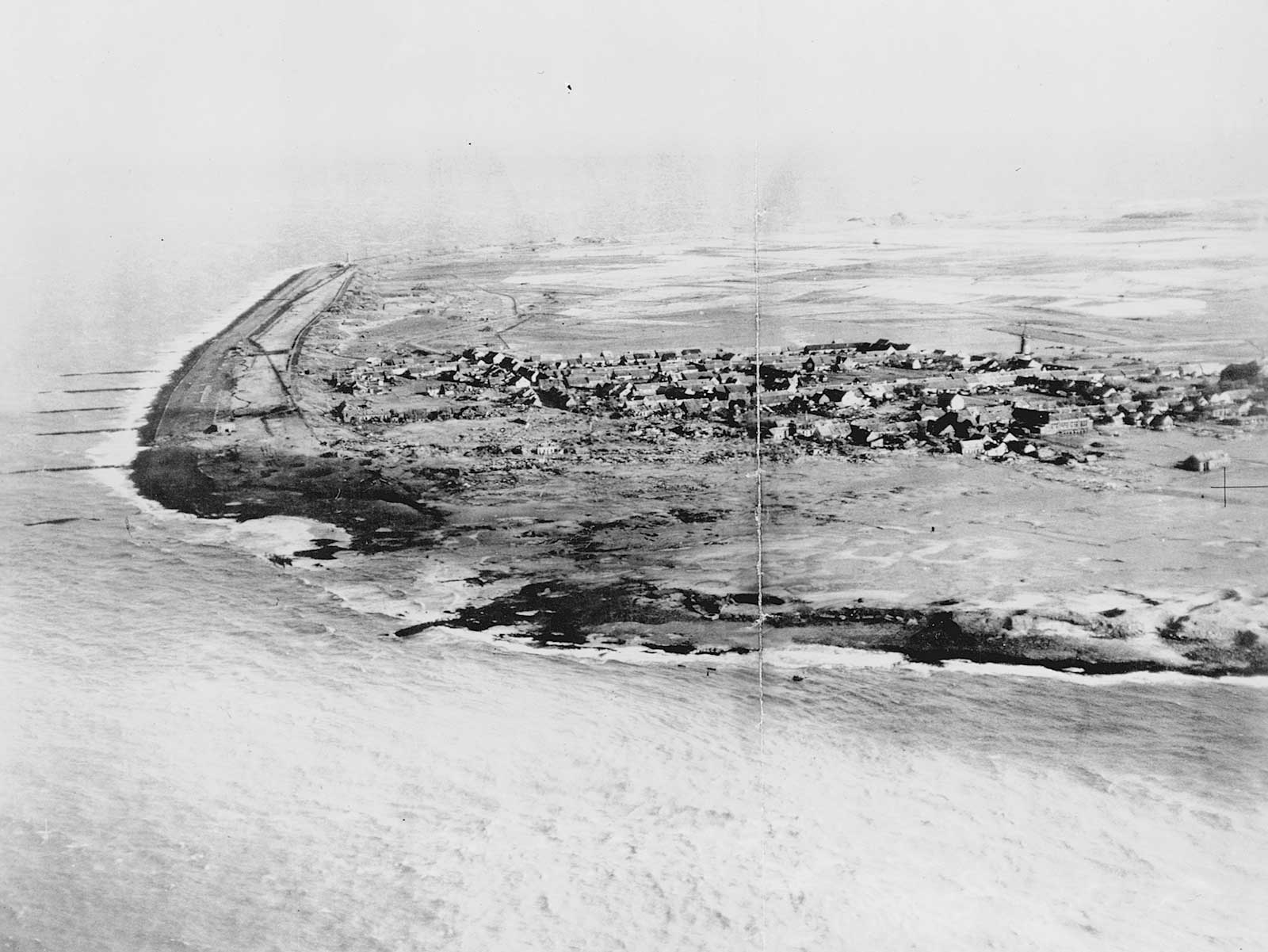 |
| Flooding and devastation after breaching the dikes in the Netherlands |
"To hamper German defence, the island's dykes were breached by attacks from RAF Bomber Command: on October 3 at Westkapelle with severe loss of civilian life; on October 7 at two places, west and east of Vlissingen; and on October 11 at Veere. This flooded the central part of the island, forcing the German defenders onto the high ground around the outside and in the towns, but it also allowed the use of amphibious vehicles." (http://en.wikipedia.org/wiki/Battle_of_the_Scheldt)
Maybe I've answered my question, but I would like to hear anything you could add. I agree with Kingsolver's protagonist that the glory of war is disappointing. In my opinion, wars are not the best solutions to problems, and should be avoided if at all possible.
 Love,
Love,~~~ Bonnie
Margareet wrote back:
Hi Bonnie Bookworm:)
Interesting part of my country's history...and I never knew this. I am familiar with another part of Holland being 'inundated' as it's called here. The Wieringermeer polder. My grandfather had a farm there in the new land, with his family. My mom was 13 in 1945, when they were warned that the dikes had been demolished (on purpose) so they had one day to gather some belongings and flee back to family in Groningen. But Walcheren, I didn't know that. It was a common way of making access impossible for foreign armies, as far back as 1000 years ago. So I can assure you that it really happened.
Please let me know if you find more about this subject, love 'talking' to you hon!!
Lots of Love, Margreet
Subscribe to:
Posts (Atom)


