Friday, May 13, 2011

Atlas Shrugged ~ by Ayn Rand, 1957, fiction

Three face-to-face friends and I have decided to read and discuss Atlas Shrugged by Ayn Rand.  It's her fourth and last novel.  I put off reading this book for years because it's over a thousand pages long.  Reading with friends will make it easier, especially since we plan to email our comments and questions to each other after each chapter.  Would any of you like to join me in discussing this philosophical book on Book Buddies?   You are welcome to start at any time and leave comments even long after the live discussion takes place.  (Click on any of the underlined links to read that part of the discussion.)
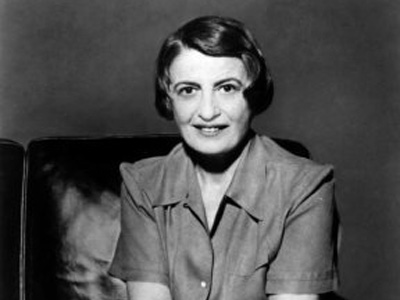
Wikipedia has lots of information about Atlas Shrugged and about Ayn Rand, the author (shown here).  This is from eNotes:
"According to a 1991 Library of Congress report, it is considered the second most influential book after the Bible in the lives of its readers. A complex combination of mystery, love story, social criticism, and philosophical concepts, the 1,100 page novel embodies the author's passionate celebration of individualism, free will, capitalism, logic, and reason. ... The apathy of the people is summed up in a new slang expression, 'Who is John Galt?' which conveys hopelessness, fear, and a sense of futility, as well as everything unachievable and imagined."
The book is divided into three parts with ten chapters in each section:
Introduction ~ by Leonard Peikoff (in the Mass Market paperback, which I have ~ if you have a different one, I'd like to hear about yours)

Part One ~ NON-CONTRADICTION

I ~ The Theme
II ~ The Chain
III ~ The Top and the Bottom
IV ~ The Immovable Movers
V ~ The Climax of the D'Anconias
VI ~ The Non-Commercial
VII ~ The Exploiters and the Exploited
VIII ~ The John Galt Line
IX ~ The Sacred and the Profane
X ~ Wyatt's Torch

Part Two ~ EITHER-OR

I ~ The Man Who Belonged on Earth
II ~ The Aristocracy of Pull
III ~ White Blackmail
IV ~ The Sanction of the Victim
V ~ Account Overdrawn
VI ~ Miracle Metal
VII ~ The Moratorium on Brains
VIII ~ By Our Love
IX ~ The Face Without Pain or Fear or Guilt
X ~ The Sign of the Dollar

Part Three ~ A IS A

I ~ Atlantis
II ~ The Utopia of Greed
III ~ Anti-Greed
IV ~ Anti-Life
V ~ Their Brothers' Keepers
VI ~ The Concerto of Deliverance
VII ~ "This is John Galt Speaking"
VIII ~ The Egoist
IX ~ The Generator
X ~In the Name of the Best Within Us
The Essentials of Objectivism
"My philosophy, in essence, is the concept of man as a heroic being, with his own happiness as the moral purpose of his life, with productive achievement as his noblest activity, and reason as his only absolute." -- Ayn Rand

Friday, May 6, 2011

To contact the Book Buddies


If you want to contact the Book Buddies,
email Bonnie at
emerging DOT paradigm AT yahoo DOT com

Thursday, February 24, 2011

Hope All is Well

Although I've missed hearing from everyone, I have been remiss about checking in as well.

This morning's word of the day is lacuna which really triggered memories of our group.

lacuna

PRONUNCIATION:
(luh-KYOO-nuh)
plural lacunae (luh-KYOO-nee) or lacunas

MEANING:
noun: An empty space, gap, missing part, an opening.


ETYMOLOGY:
From Latin lacuna (hole, gap), from lacus (lake). Earliest documented use: 1663.


USAGE:
"Last week's collision between two cargo ships off the coast of Mumbai has exposed several systemic lacunae."
Black Waters; The Times of India (New Delhi, India); Aug 11, 2010.


Losing touch with our group has left a lacuna in my life.

Are you all right Bonnie? Rest of group? Are we going to try to continue the group reads?

Monday, December 6, 2010

Housekeeper and Professor ~ discussion questions

Hanshin Koshien Stadium
Discussion Questions (from the publisher)

1. The characters in The Housekeeper and the Professor  are nameless (“Root” is only a nickname). What does it  mean when an author chooses not to name the people in her book? How does that change your relationship to them as a reader? Are names that important?

2. Imagine you are  a writer, developing a character with only eighty minutes of short-term memory. How would you manage the very specific terms of  that character (e.g. his job, his friendships, how he takes care of himself)? Discuss some of the creative ways in which Yoko Ogawa imagines her memory-impaired Professor, from the  notes pinned to his suit to the sadness he feels every morning.

3. As Root and the Housekeeper grow and move forward in their lives, the Professor stays in one place (in fact he is deteriorating, moving backwards). And yet, the bond among  the three of them grows strong. How is it possible for  this seemingly one-sided relationship to thrive? What  does Ogawa seem to be saying about memory and the very foundations of  our profoundest relationships?

4. The Professor tells  the Housekeeper:  “Math has proven the existence of God because it is absolute and without contradiction; but the devil must exist  as well, because we cannot prove it.” Does this paradox  apply to anything else, beside math? Perhaps memory?  Love?

5. The Houskeeper’s father abandoned her mother before she was born; and then the Housekeeper herself  suffered the same fate when pregnant with Root. In a book where all of the families are broken (including the Professor’s), what  do you think Ogawa is saying about how families are composed?  Do we all, in fact, have a fundamental desire to be a part of a family?  Does it matter whom it’s made of?

6.  Did your opinion of the Professor change when you realized the nature of his relationship with his sister-in-law? Did you detect any romantic tension between the Professor and the Housekeeper, or was their relationship chaste? Perhaps Ogawa was intending ambiguity in that regard?

7.  The sum of all numbers between one and ten is not difficult to figure out, but the Professor insists that Root find the answer  in a particular way.  Ultimately Root and the Housekeeper come to the answer together. Is there a thematic importance to their method of solving the problem?  Generally, how does Ogawa use math to  illustrate a whole worldview?

8. Baseball is a game full of statistics, and therefore numbers.  Discuss the very different ways in which Root and the Professor love the game.

9.  How does Ogawa depict the culture of contemporary Japan in The  Housekeeper and the Professor? In what ways does is it  seem different from western culture? For example, consider the Housekeeper’s pregnancy and her attitude toward single  motherhood; or perhaps look at the simple details of the  story, like Root’s birthday cake. In what ways are the  cultures similar, different?

10. Ogawa chooses to write  about actual math problems, rather than to write about math in the abstract. In a sense, she invites the reader to learn math  along with the characters. Why do you think she wrote the book this way?  Perhaps to heighten your sympathy for the characters?

11.  Do numbers bear any significance on the structure of this book?  Consider the fact that the book has eleven chapters. Are  all things quantifiable, and all numbers fraught with poetic  possibility?

Those unnamed people in our book


According to Wikipedia, The Professor's Beloved Equation is the title published in Japan in 2003; The Housekeeper and the Professor is the English translation by Stephen Snyder, which was published in 2009.  The same article tells us about the characters:
The Professor ~ 64 years old. A former university professor who specializes in number theory. He loves mathematics, children, and the Hanshin Tigers (especially Yutaka Enatsu, who was playing for the Tigers at the time of the Professor's accident and whose uniform number was 28, the second smallest perfect number. After being in an accident at the age of 47, he can retain new memories for only 80 minutes. He keeps important information on memo paper which is attached all over his suits. He keeps baseball cards and another important memento in a cookie tin. He has trouble interacting with other people and has a habit of talking about numbers when he does not know what else to say. He has a talent for reading things backwards and finding the first star in the sky.

The narrator ~ housekeeper and single mother. Initially feels frustration at the Professor, who shows interest only in mathematics, but through observing the Professor's kindness and his passion for mathematics, comes to feel respect and affection for him. She first manages to connect with the Professor when he discovers that her birthday is February 20 (220), which is an amicable number with the number 284, which is imprinted on the underside of his watch, which he received as the University President's Award for a thesis he wrote in university on transcendental number theory. Cannot pronounce the title of the Journal of Mathematics (to which the Professor submits contest entries) very well, so she refers to it as "Jaanaru obu." Gives the Professor a rare baseball card of Yutaka Enatsu as a birthday present.

Root ~ ten years old. The Professor refers to him as "Root" on account of the top of his head being flat like a square root (√) symbol. Is a fan of the Hanshin Tigers, and gets the Professor to repair his radio so that they can listen to baseball broadcasts together. Eventually becomes a junior high school mathematics teacher.

The Widow ~ sister-in-law of the Professor (wife of the Professor's brother). Cannot walk well, as a result of a traffic accident.

Sunday, November 21, 2010

Discussion questions ~ Bonnie's answers

click to enlarge
This photo shows a cenote, defined as "a deep natural well or sinkhole, especially in Central America, formed by the collapse of surface limestone that exposes ground water underneath, and sometimes used by the ancient Mayans for sacrificial offerings."

8.  Frida tells Harrison, "The most important thing about a person is always the thing you don't know" (p. 218).  Years later, he writes to her, saying, "Frida, you always said the most important thing about any person is what you don't know.  Likewise, then, the most important part of any story is the missing piece" (p. 277).  How does this relate to the book's title?
Alison said (in a comment) that she's "still working on The Lacuna."  Getting through it was like work, in some ways.  The story wasn't exciting enough to pull me along, but when I reached the last part and the whole thing came together, I was left feeling very satisfied with the book.  I guess you can tell from the second set of questions (where I posted a different picture of an underwater cave) that part of my enjoyment came from the cave called "la lacuna" hidden beneath the waves.

A lacuna is a gap or missing part.  People seemed to think, for example, that they knew the author named Harrison Shepherd because they had read his books or because newspapers reported this or that about him.  At the end of the book (something for you to look forward to, Alison), Mrs. Brown discovered a gap in her knowledge of the man, when she realized she didn't know some important things about him, even though she had worked for him for years and had even traveled with him on business a time or two.  That's the lacuna that matters.
Joe McCarthy with his aide Roy Cohen
11.  Were you surprised by the way statements were twisted during the McCarthy trials?
Like Shirley (see the comments), I was really drawn to what Barbara Kingsolver wrote about the McCarthy period.  I remember how uneasy I felt about the televised hearings, even at the age of twelve, when we got our first television in 1952.  I cringed at the thought of Senator McCarthy ruining the lives of so many people, realizing, even then, that there was no way to refute the nebulous charges.
9. Did you like the format, using journals and letters?
10. What did you think of Violet Brown, who worked for Harrison?

Violet Brown was a mousy little woman, but she was completely loyal to her boss.  I can't say I liked her much, otherwise.  And she's the one (other than the book's author) who gets the blame for what we call "the format" of the story, using journals and letters.  Mrs. Brown is the one who chose what to include, which thing should come next, and how the whole fit together.
1.  Do Harrison's diaries feel realistic to you?  Does he sound like a 12-year-old at the beginning ... and later like a mature man?  What kind of boy was he?  What do you think of him?
12.  How did Harrison Shepherd change over the course of the novel?
Yes, his "later" writings seemed more mature, but no, the early ones didn't quite seem like the writings of a child.  Maybe it's because I'm teaching two writing classes that I'm aware of the meticulous wording and punctuation in his early diaries, so I'll forgive the (mostly) perfect entries -- except for an occasional comma splice or two.  (grin)  Harrison Shepherd became more reserved as he became aware of his own sexuality and of the world's unfathomable ways of treating anyone who thinks differently.  And finally, he was almost a hermit, trying to keep away from those who admired or hated him.  What he longed for, finally, was the ultimate escape.
7.   What new things have you learned from reading this book?
I've read reviews of The Lacuna by lots of people, including some who thought the author brought in too many famous people.  I think her choices worked the other way around, that she used the fact that Frida Kahlo, Diego Rivera, and Leon Trotsky were
Trotsky
all together in one place and time and plunked her protagonist (Harrison Shepherd) down in the midst of them.  Because these people were in the book, I looked them up and read more about them, finding Diego's mural in Detroit and his famous mural in Mexico City because I was really learning something about these people in depth for the first time -- even though I'd heard their names and could have told you a fact or two about Trotsky.

December's choice ~ The Housekeeper and the Professor

The Housekeeper and the Professor by Yoko Ogawa is the book we chose for December, and it is almost time to start reading it.  Here's a summary from the publisher:
He is a brilliant math Professor with a peculiar problem -- ever since a traumatic head injury, he has lived with only eighty minutes of short-term memory.  She is an astute young Housekeeper, with a ten-year-old son, who is hired to care for him.  And every morning, as the Professor and the Housekeeper are introduced to each other anew, a strange and beautiful relationship blossoms between them.  Though he cannot hold memories for long (his brain is like a tape that begins to erase itself every eighty minutes), the Professor’s mind is still alive with elegant equations from the past.  And the numbers, in all of their articulate order, reveal a sheltering and poetic world to both the Housekeeper and her young son.  The Professor is capable of discovering connections between the simplest of quantities -- like the Housekeeper’s shoe size -- and the universe at large, drawing their lives ever closer and more profoundly together, even as his memory slips away.  The Housekeeper and the Professor is an enchanting story about what it means to live in the present, and about the curious equations that can create a family.
According to Wikipedia, The Professor's Beloved Equation is the title published in Japan in 2003; The Housekeeper and the Professor is the English translation by Stephen Snyder, which was published in 2009.